
Tax season is approaching fast, which means we are all trying to prepare and save money where we can. Luckily for you, Section 179 has a way for your small to medium sized business to save money. While some may already know about this tax deduction, there are new changes for the 2023 tax year that business owners should be aware of if you are planning to use Section 179.
Please note that Flight Systems Industrial Products (FSIP) IS NOT tax experts or advisors. Please seek a professional tax advisor or talk to your tax accountant before deciding if this tax deduction is right for you and your business.
We are also not responsible for any faults with tax returns. Not qualifying for Section 179 IS NOT grounds for a refund on purchased products. All referenced numbers in this blog are subject to change without notice by the IRS.
What is Section 179?
Section 179, also known as the Section 179 Deduction, is a tax provision that allows businesses to deduct the full purchase price of qualifying equipment and software in the year it was purchased. This deduction was designed to encourage small to medium sized businesses to invest in their growth by providing them with a more immediate tax benefit.
With Section 179, businesses can write off equipment (up to the maximum amount of $1,160,000) instead of depreciating it over time in the upcoming tax years. Businesses can additionally take advantage of 80% bonus depreciation on both new and used equipment for the 2023 tax season as long as it is purchased and put in-use by 12/31.
What’s new to Section 179?
There have been a few important changes from the 2022 to the 2023 tax season. The maximum deduction has been increased to $1,160,000 from last year’s $1,080,000. Additionally, the total equipment purchase limit has been increased to $2,890,000 from the $2.7 million purchase limit from the previous year.
What Qualifies?
Section 179 covers a range of both new and used equipment. The following equipment qualifies as long as it is new to the buyer, is used for more than 50% for business, and it was purchased and put in-use within the current tax year you are trying to deduct it from.*
- Machinery and equipment
- Office equipment and furniture
- Computers and “off-the-shelf” software
- i.e., not custom-made or modified specifically for your business
- Property attached to a building that is not structural components
- Refrigerator
- Signs
- Air conditioners/heaters
- Vehicles
- Any four-wheeled vehicle that is designed to carry passengers including cars, trucks, vans, and SUVs that weigh between 6,000–14,000 pounds qualify for a portion of Section 179 at the very least.
- The limits on deduction listed above DO NOT apply to all vehicles. Vehicles that are designated for work-only do not have these limitations. These vehicles include ambulances, hearses, any vehicle with a cargo area that measures 6 feet or more, and any truck or van that is designed to carry more than nine passengers.
- Eligible improvement to non-residential buildings
- Roofs
- Security systems
- Fire alarm and protection systems
- HVAC and ventilation
*Purchased and put “in-use” is defined by “the moment a piece of property is ready and available for a specific use.” For example, if the equipment was purchased in 2023 and you plan to deduct it, it must be in-use by midnight on December 31st, 2023, for it to be an eligible deduction. If it is not put in-use by the end of the last day of the year, it will no longer be eligible for Section 179.
It is important to note that the equipment must be acquired by the company through an exchange of money for it to count for the Section 179 deduction. It cannot be inherited or gifted.
Who qualifies?
Any business that purchases, leases, or finances new or used business equipment qualify for Section 179 assuming they spend less than $4,050,000 (this was raised from 2022’s $3,780,000). After a business spends more than $2,890,000 in qualified assets, the deduction phases out dollar-for-dollar until they hit the max spending limit of $4,050,000, in which case the entire deduction becomes obsolete.
What’s the difference between Section 179 and Bonus Depreciation?
Section 179 was designed for small to medium sized businesses. This is why the entire deduction goes away when a business spends more than the max spending limit, which for the year of 2023 is $4,050,000.
Bonus depreciation is a tax incentive that is useful for businesses that spend above Section 179’s max spending limit since it has no spending cap. This essentially allows businesses to accelerate the depreciation of qualifying assets rather than writing them off over the useful life of said assets.
How does this apply to you and FSIP?
We understand that many industrial-level machinery and regenerative products are not cheap, and that these bigger purchases depreciate over time. That’s where Section 179 could apply to you. This deduction can help to balance high up-front costs like our Xtender Battery Regenerator and Smart Discharger.
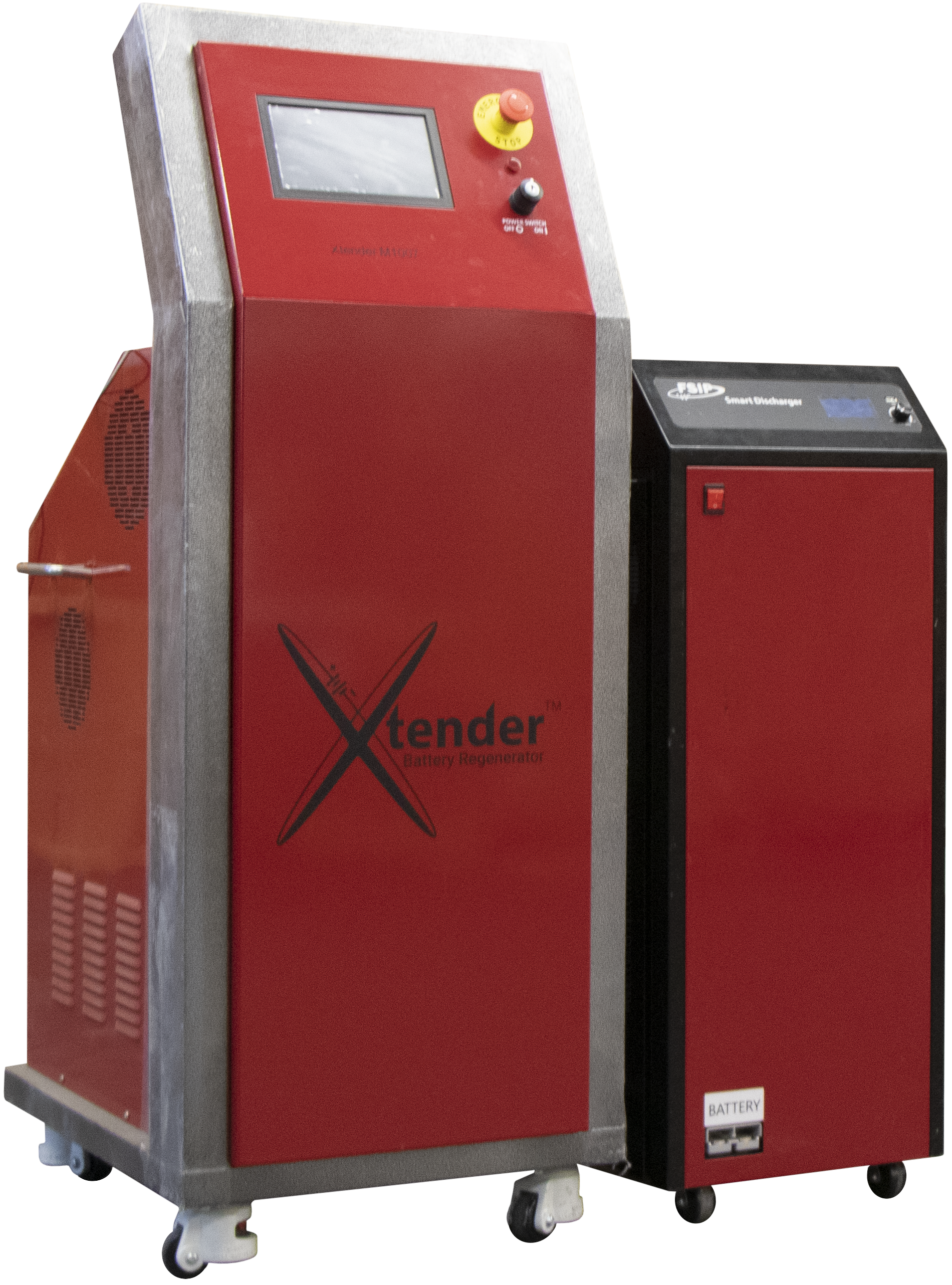
FSIP is the exclusive distributor of the Xtender, the all-in-one, fully automated machine for discharging, desulfating, and restoring lead-acid batteries. This unit will extend your battery’s life, which helps save you money and reduces downtime costs. This machine can be paired with our Smart Discharger and Battery Monitoring System (BMS) to provide automatic graphical analyses of a battery’s remaining capacity and transfer the data to your PC, identify faulty cells, discharge batteries at a constant, controlled rate, and requires no manual adjustments throughout the process.
Interested to see how the Xtender Battery Regenerator and Smart Discharger works? Contact a sales rep at xtender@fsip.biz for more information.
Calculate your Estimated savings
Wondering how much you could save with Section 179? Section179.org provides you a calculator to determine what your potential savings would be.
Please remember this calculator provides estimated savings and does not guarantee your actual tax savings.
 FSIP's Blog